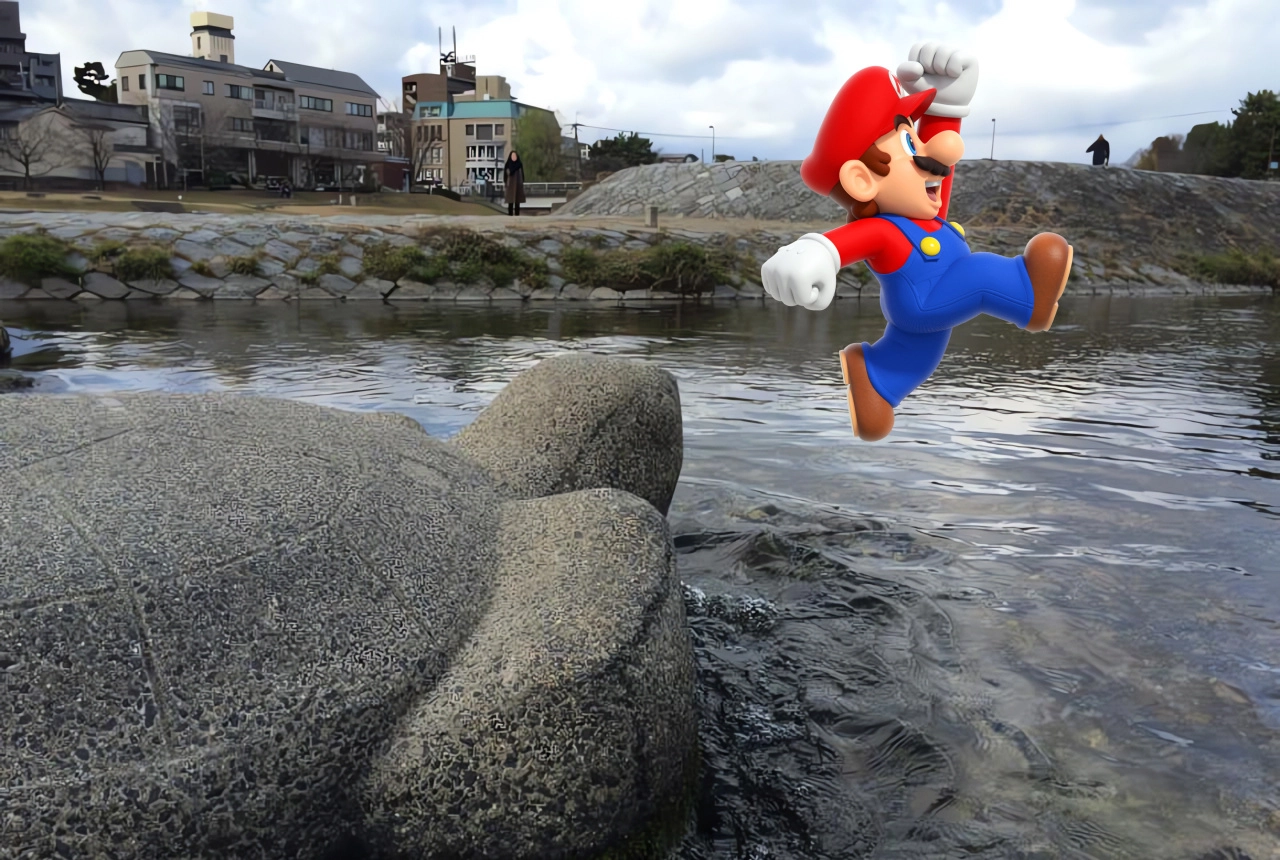
In the quaint and culturally rich city of Kyoto, a curious feature has captured the imagination of both locals and visitors alike. Amidst the city's canals, a series of turtle-shaped stepping stones offer a unique means for pedestrians to traverse the shallow waters. What makes these stones remarkably fascinating, beyond their functional charm, is a speculated link to the world of video games—specifically, Nintendo’s cornerstone franchise, Super Mario.
These turtle stones are more than just pathway slabs; they have become subjects of intrigue due to their potential connection to one of gaming's most beloved mechanics: the act of jumping on turtle enemies in Super Mario. This juxtaposition between Kyoto's scenic crossings and an iconic video game action is both coincidental and alluring, considering that Kyoto is also the birthplace of Nintendo.
The intrigue around these stones started gaining attention when former games journalist Frank O'Connor, during an interview, spoke about discovering these turtle stones in Kyoto and described how crossing them seemed reminiscent of Mario's turtle-hopping adventures. The imagery of leaping from stone to stone, over a body of water with fish swimming below, bore an uncanny resemblance to scenes straight out of a Mario game. As he ventured across, O'Connor couldn't help but draw parallels to his youthful encounters with Super Mario Bros., where navigating over in-game hazards by jumping on turtle-like creatures known as Koopas was a staple.
This delightful correlation stirred curiosity and led to further discussion about whether the turtle stones could have been an inspiration for Shigeru Miyamoto, the creator of Mario. Given that the stepping stones are located in Nintendo's hometown and considering Miyamoto's known habit of drawing creative influence from his own life experiences and the world around him, the link seemed plausible. He has spoken in the past about his childhood expeditions around Kyoto’s caves, temples, and forests, which later became creative fodder for The Legend of Zelda series.
Attempting to uncover this link, journalists and researchers looked to historical records and interviewed key figures, including the designers of the stepping stones themselves. They found that the turtle stepping stones, alongside others shaped like plovers and boats, were not as ancient as one might assume. They were installed around the early 1990s, which is significantly later than the release of the original Super Mario Bros. game in 1985. The stepping stones served a practical purpose of protecting the riverbed from erosion and providing a playful element to the riverside environment. This timeline suggests that the Super Mario series could not have been directly influenced by these structures as they came after the game's inception.
The quirky stepping stones certainly have their charm and have become a noteworthy feature of Kyoto's urban landscape. Even if their connection to Super Mario Bros. is coincidental or unproven, the discussion around them sheds light on the permeable border between life and art. It's not unusual for game developers to embed elements of the real world into their digital creations, and in some instances, real-world designs may take a nod from the cultural impact of video games.
Whether the predecessor to this design is art or reality remains a charming anecdote rather than a verified truth. Yet, the idea that Kyoto's turtle stepping stones might have a connection to one of the most iconic video games highlights the pervasive nature of gaming culture and its unexpected intersections with our physical spaces.
Interestingly, Frank O'Connor had the chance to meet Miyamoto during a trip to Japan and inquired about various environmental inspirations for his games. While Miyamoto smilingly acknowledged the connections, it remains unclear whether he directly confirmed the turtle stepping stones as a source of inspiration. The absence of explicit acknowledgment leaves the Mario-turtle stone relationship as an compelling mystery—a spark for the imagination that resonates with fans.
Visitors to Kyoto can still enjoy these stepping stones, regardless of their inception story. They serve as a whimsical reminder that even in the most ordinary of urban landscapes, there can be elements of magic and playfulness that evoke the joys of video gaming history. Whether these stones were inspired by Super Mario or are a curious case of life imitating art, they continue to fuel the wonder of how our real-world experiences may be intertwined with the virtual worlds we cherish.

You must be logged in to post a comment!
