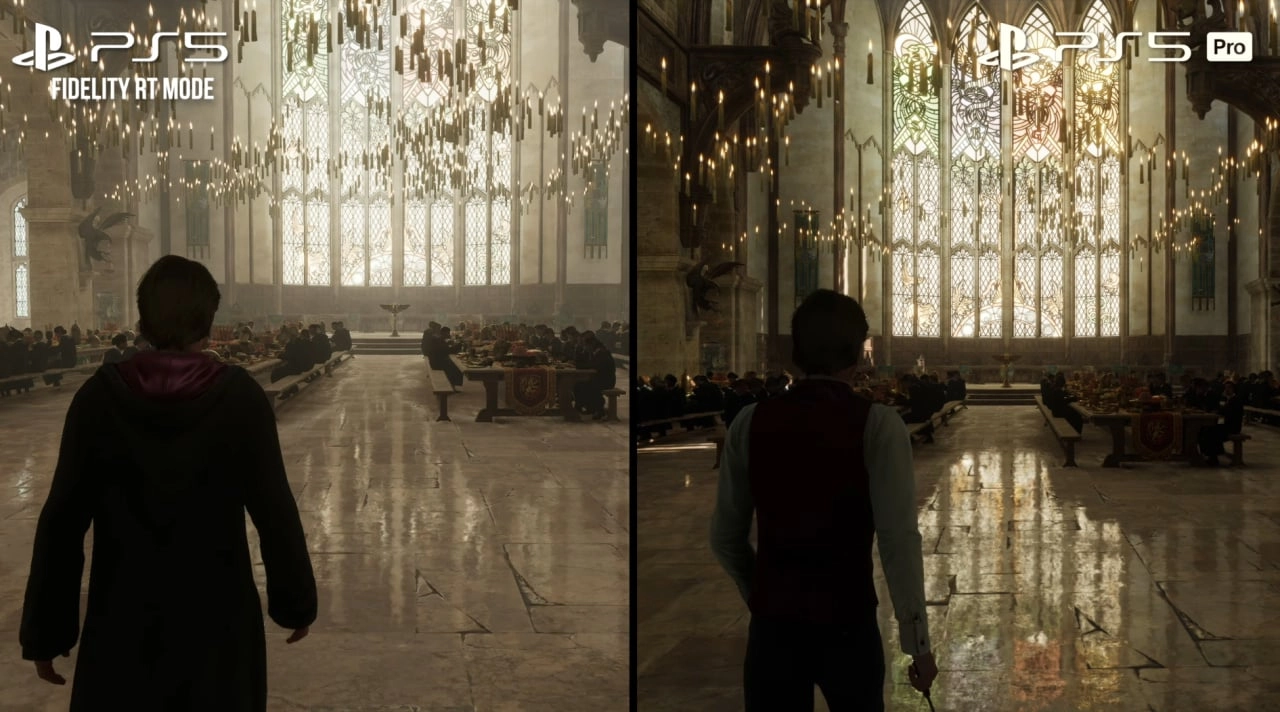
The PlayStation 5 Pro, still in its early stages, has recently been analyzed by experts at Digital Foundry, revealing potential significant improvements over the original PS5 model. The analysis focused on several technical enhancements that could change the way games are played and experienced on Sony's next-generation console.
Sony's PlayStation 5 has been a major player in the gaming industry, known for its high-quality graphics and smooth performance. However, as technology evolves, so does the need for more advanced gaming systems. Enter the PS5 Pro, which aims to push the boundaries even further. Despite concerns about its price and whether the improvements justify the cost, the PS5 Pro shows real potential in elevating the gaming experience.
One of the main features under examination is the PlayStation Spectral Super Resolution (PSSR), an AI-powered technology designed to enhance image quality. This feature is particularly crucial as it aims to refine how visuals are rendered on the screen, focusing not just on the quantity of pixels but on enhancing the quality of those pixels. For example, some games on the PS5 Pro might operate at internal resolutions as low as 864p. However, with PSSR technology, the overall image quality is boosted, diminishing the impact of lower base pixel counts.
This focus on pixel quality over pixel quantity represents a shift in the gaming industry's approach to visual fidelity. While traditionally, higher resolutions like 1080p or 4K have been benchmarks for assessing image quality, the emphasis is now shifting towards how these pixels are rendered more effectively to produce better visuals, regardless of the raw pixel count.
Digital Foundry's Richard Leadbetter highlighted the additional GPU horsepower, enhanced ray tracing capabilities, and machine learning capacities of the PS5 Pro. These improvements are designed to work in tandem to deliver superior visual quality from a more holistic standpoint. The internal resolution, according to Leadbetter, is merely one component of the overall image quality.
However, it's important to note that PSSR, while promising, isn't yet on par with the industry-standard Deep Learning Super Sampling (DLSS) used by competing platforms. But early indications show that it does represent an improvement over AMD's FidelityFX Super Resolution 2 (FSR 2), particularly when running at very low resolutions.
The preliminary analysis was based on a high-resolution rendering of a presentation by Mark Cerny, known for his work on PlayStation hardware. This indicates that while the current builds might not represent the final product, there is already a basis for optimism regarding what the PS5 Pro might offer upon its release.
Despite these promising features, the debate continues regarding the PS5 Pro's pricing, which some consumers find too high compared to the offered enhancements. While some gamers might not see the value in upgrading from a standard PS5 to a Pro version at a significant cost, others might view these enhancements as a worthwhile investment for a superior gaming experience.
Additionally, it's worth mentioning that the PS5 Pro's capabilities could evolve further. With more time for development and feedback, Sony could refine the system's features to better justify its cost. As new games are developed to specifically take advantage of the PS5 Pro's capabilities, it could further solidify its position in the market as a desirable upgrade for dedicated gamers seeking the best possible experience.
The PS5 Pro represents a forward-thinking approach to gaming technology, focusing on deepening the quality of gameplay visuals and AI integration. As development continues and more games are optimized for this new system, the true value of the PS5 Pro will likely become more apparent to the gaming community.

You must be logged in to post a comment!
