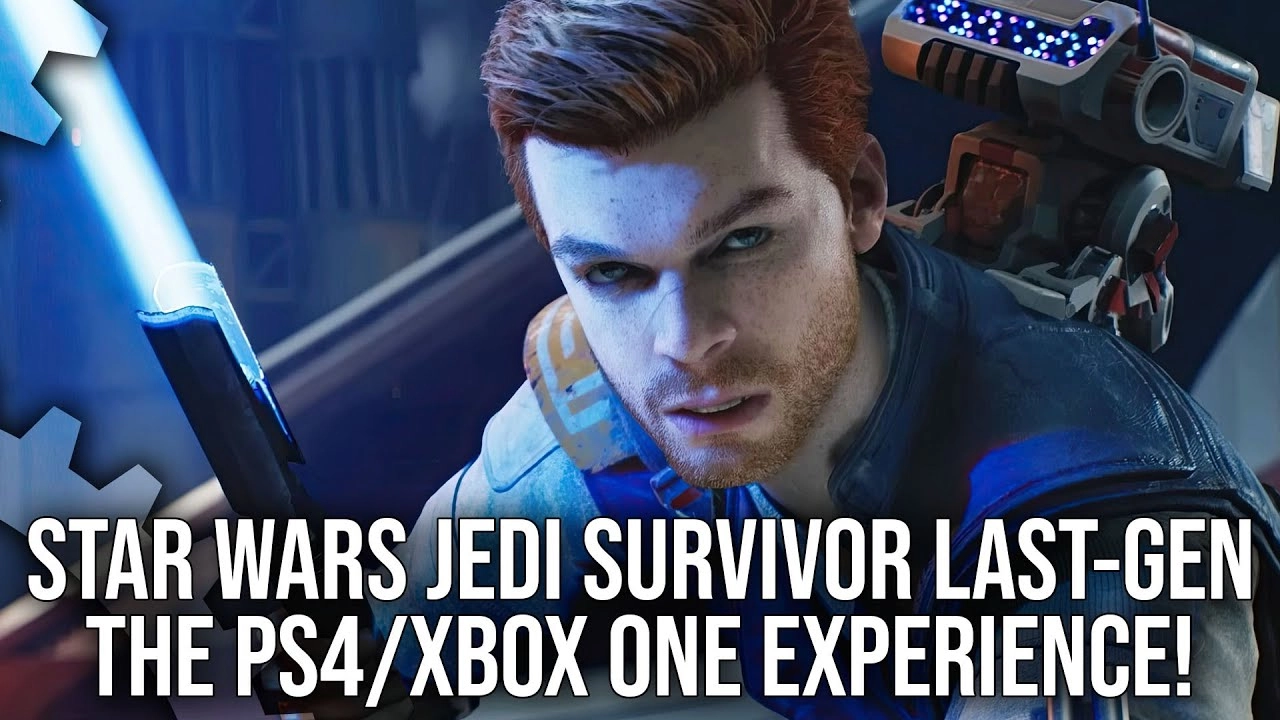
Released recently for the PlayStation 4, Star Wars Jedi: Survivor has sparked discussions primarily centered on its technical performance. This scrutiny is understandable given that even the PlayStation 5 version of the game has not been without its flaws in specific areas. However, it’s the PS4 version that has undergone notable reductions in game quality to ensure it runs on this older platform, which is now nearly 11 years old.
The game, while maintaining the core gameplay that fans expect, has seen various cuts in its transition to the PS4, particularly noticeable when played on the base version of the console. Digital Foundry, a team that specializes in technical analysis of games, has identified multiple areas where the game has been scaled back. They report a reduced resolution of 1280x720 on the base PS4, as well as decreased quality in pre-rendered cutscenes, texture assets, and audio bitrates.
One of the most evident issues for those playing on PS4 is the slow load times. Entering the game’s open zone, Koboh, takes substantially longer on the PS4 – over two minutes – compared to just 10 seconds on the PS5. Similarly, transitioning from the outside world into the interior of locations like Pyloon’s Saloon can leave players waiting 10 to 15 seconds for doors to open.
Despite these drawbacks, much of the game's intrinsic design and detail remain intact. The attention to elements such as the detailing on droids and dense object placement around key locations is commendable. The game also retains physics-based interactions, which are crucial for maintaining the integrity of gameplay. For instance, the way Stormtroopers’ bodies react to forces or how cables react to contact with a lightsaber remains engaging and authentic to the Star Wars universe.
Moreover, during gameplay, the goal of maintaining a frame rate of 30 frames per second is generally met on the base PS4, although there are occasional drops when the game streams new assets as the player navigates the environment quickly.
For players using the PS4 Pro, the experience improves significantly. With a higher resolution of 864p, the image quality is clearer, and the frame rate during gameplay is more stable. Issues such as tearing and uneven frame pacing, prevalent on the base PS4, are markedly reduced on the Pro model. However, even on the PS4 Pro, in-engine cutscenes can still experience some hitches.
Digital Foundry sums up the experience of Star Wars Jedi: Survivor on last-gen consoles as mixed. While they find it difficult to recommend the base PS4 and Xbox One versions due to visual cutbacks and frame rate instabilities during cut-scenes, the PS4 Pro and Xbox One X versions offer a more convincing experience. This is attributed to a more consistent frame rate lock at 30fps and improved image quality.
For players still on older console versions, this situation poses a dilemma: to either struggle with the compromised performance or possibly consider hardware upgrades if they seek the best experience. As the gaming world continues to evolve with more technically demanding titles, the disparity between console generations becomes increasingly stark.
In summary, while Star Wars Jedi: Survivor remains a compelling game in its core gameplay aspects, the technical concessions on the PS4 platform pose significant challenges. Players may need to weigh their tolerance for these issues against their desire to dive into another adventure in the Star Wars universe. Whether the trade-offs are worth it will depend largely on personal preferences and the hardware available to individual players.

You must be logged in to post a comment!
