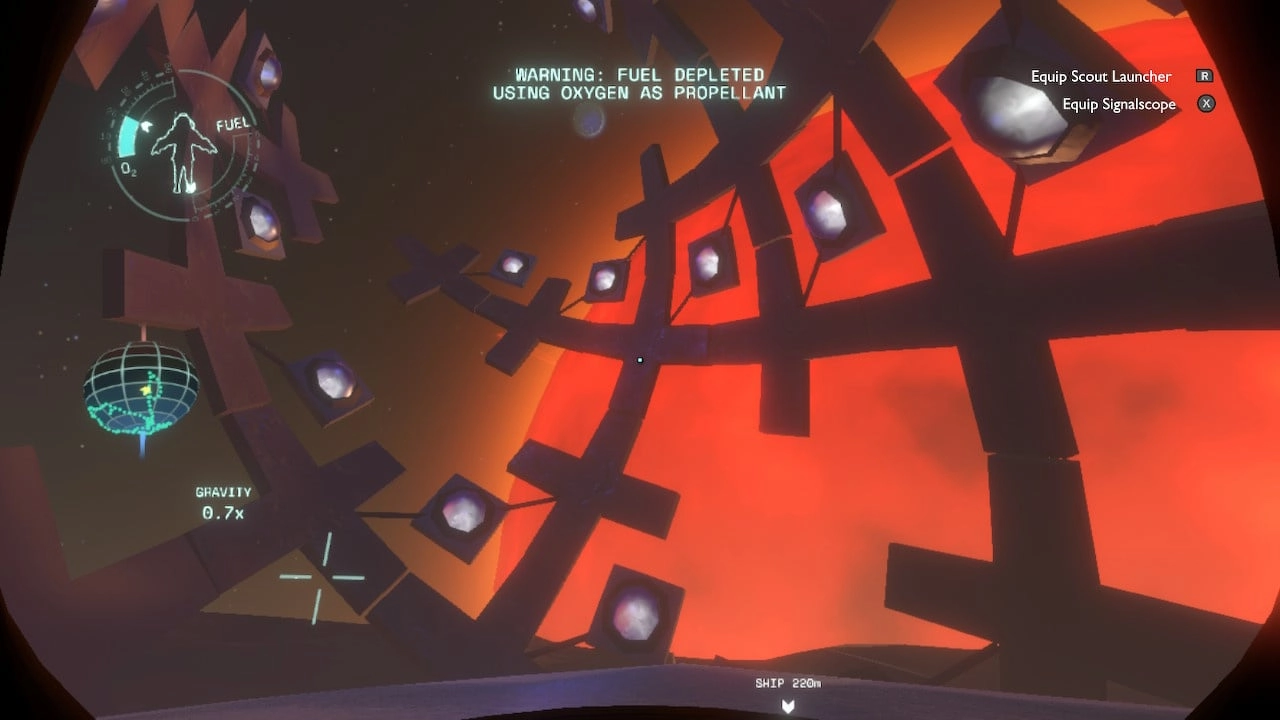
Imagine embarking on a journey through the cosmos, exploring alien planets, and uncovering the universe's mysteries—all within a time loop that resets with every death. This is the thrilling experience offered by Outer Wilds, an indie space exploration game that has earned high praise since its original release in 2019 on PC and Xbox. Now, it has made its voyage to the Nintendo Switch, along with the Echoes of the Eye DLC in the Archaeologist’s Edition.
Outer Wilds presents players with a vast, miniature solar system to explore, encased in a time loop narrative that challenges both intellect and emotion. From the very beginning, set in a small village on a forested planet, players step into the shoes of a fresh astronaut about to take off on their inaugural space flight, an event that will recur indefinitely. Using a simple yet sophisticated control scheme, including a spaceship and jetpack, players navigate the depths of space with a profound sense of freedom and discovery. The game's controls may seem complex at first, with a myriad of buttons and sticks to manage, but they coalesce into a fluid and thrilling way to explore the game's landscapes, from docking with ancient spacecraft to racing across alien terrain.
The crux of Outer Wilds lies in its storytelling, cleverly wrapped in gameplay that revolves entirely around unveiling secrets. Each playthrough, each death, and each loop is a chance to gain knowledge that remains with players even when their character resets. It is this incremental learning—which can be likened to the repetition and skill-building seen in films like Edge of Tomorrow and Groundhog Day—that forms the player's progression through the game, without any traditional in-game skill trees or unlockables.
The game’s open-world design allows for spontaneous discovery and can lead players to stumble upon story clues and mysteries organically. As such, initial gameplay can feel daunting due to the lack of direction, and a bit of guidance would have been helpful to ease players into the game's mechanics and world. Nevertheless, persistent players will find joy in the game's dedication to self-driven exploration and learning.
Outer Wilds on Switch, however, does face technical challenges. Players eager for a flawless performance may be disappointed as the game often runs below the ideal 30 frames per second, accompanied by occasional audio issues and graphical compromises. Despite these hurdles, the game's forgiving physics and the lenient consequences of crashing somewhat mitigate the impact of these technical issues.
The visual and auditory artistry of Outer Wilds plays a pivotal role in creating an immersive experience. It boasts an art direction that remains effective even on the less powerful hardware of the Switch, helping to gloss over the technical downscaling necessary for the game's handheld format. While perfect visual fidelity isn't the heart of Outer Wilds—story and exploration are—it's worth noting these graphical downgrades for players who prioritize aesthetics.
For those with access to Outer Wilds on other platforms, especially if the occasional stuttering and frame rate drops are a concern, experiencing the game on a more powerful system might be the preferred choice. Yet, this should not detract from the fact that Outer Wilds remains a captivating and beautifully crafted game on Switch, with its story-centric gameplay intact.
Outer Wilds extends an invitation to Nintendo Switch players to join in an unforgettable space exploration adventure. The spirit of curiosity, the thrill of discovery, and the satisfaction of unraveling a celestial puzzle all contribute to the enchanting experience that awaits within this indie masterpiece—stupefying technical issues take a back seat when the vast expanse of the universe beckons.

You must be logged in to post a comment!
