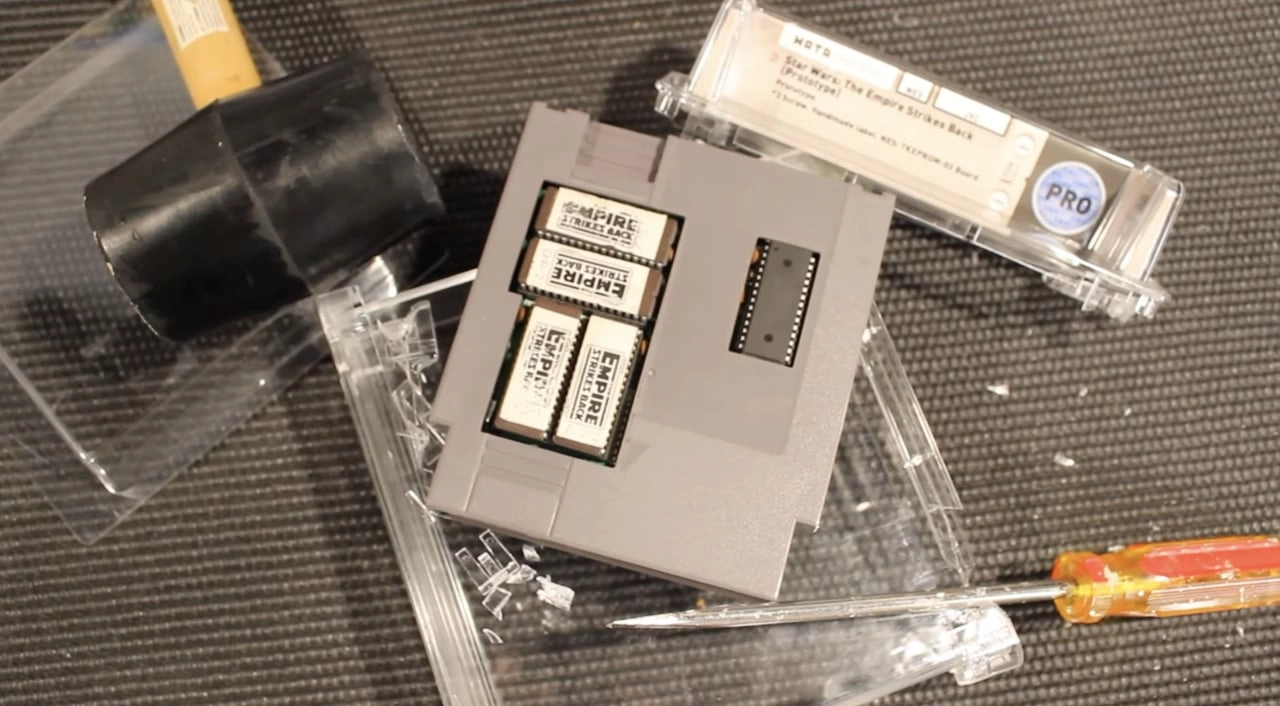
In the world of video game collection and preservation, few subjects stir as much debate as the practice of grading game cartridges, especially rare prototypes that have never been commercially released. These prototypes are essential pieces of gaming history that provide valuable insights into the development process of popular games. Recently, a significant event in the game preservation community unfolded when a rare prototype of "Star your Wars: Empire Strikes Back" for the Nintendo Entertainment System (NES) was freed from its restrictive plastic grading case.
The graded game cartridge was entrusted to the YouTube channel Hard4Games, known for its dedication to exploring and preserving video game history. This particular cartridge had been sealed and graded by WATA (Water Authentication and Grading Authority), a company that specializes in the appraisal and certification of collectible video games. The process of removing the game from its sealed case was not trivial; it required considerable effort, highlighting the impracticality and potential damage of encasing such historically significant items in plastic prisons.
Once liberated, the Hard4Games team took an important step by dumping the ROM (Read-Only Memory) of the game. Dumping the ROM involves copying the game data from the cartridge onto a computer, ensuring it can be preserved digitally for future generations and studied by historians and enthusiasts without the need to handle the original physical media. This digital preservation allows for easier access and research, facilitating a deeper understanding of the game's development and variations from final commercial releases.
Interestingly, after the extraction and preservation work, the team found a novel use for the now-empty WATA case by using it as a makeshift bowl for snacks and drinks during their session. This light-hearted act underscored their stance on the impracticality of such rigid grading and storage practices for game cartridges that deserve to be appreciated more interactively.
Despite the effort put into freeing and preserving the game, the team discovered that this prototype of "Star Wars: Empire Strikes Back" had minimal differences from the final version released to the public, which was widely criticized upon its release. The lack of significant differences in this prototype might seem like a disappointment; however, it still represents a critical part of video gaming lore and serves as a physical testament to the game development process back in the era of the NES.
The act of freeing this game from its plastic casing is not merely about allowing physical access to the cartridge but is more profoundly a statement against the commercialization and isolation of video game prototypes that should instead be accessible for educational and preservation purposes. Each prototype, like the one from "Star Wars: Empire Strikes Back," offers a snapshot into the development stages of games, reflecting choices, alterations, and sometimes, the abrupt changes in direction that developers might have taken during a game's creation.
Releasing prototypes from their graded tombs offers them a second life where they can educate and inform. For video game historians and preservationists, access to such prototypes allows them to compile a more nuanced history of video games, examining what might have been and understanding the evolutionary path of game design choices.
Preserving video game history is crucial as it provides insight not just into the technology and design of the era, but also into the cultural context surrounding a game's creation and reception. Actions like those taken by Hard4Games support the broader movement toward recognizing video games as significant cultural artifacts that warrant the same respect and preservation efforts traditionally reserved for other forms of art and historical materials.
Through initiatives like these, the community continues to advocate for the importance of accessibility and preservation over profit and exclusivity, ensuring that future generations can study and appreciate the rich history of video gaming. This incident with the "Star Wars: Empire Strikes Back" NES prototype serves as a compelling reminder of the ongoing challenges and triumphs in the field of video game preservation.

You must be logged in to post a comment!
