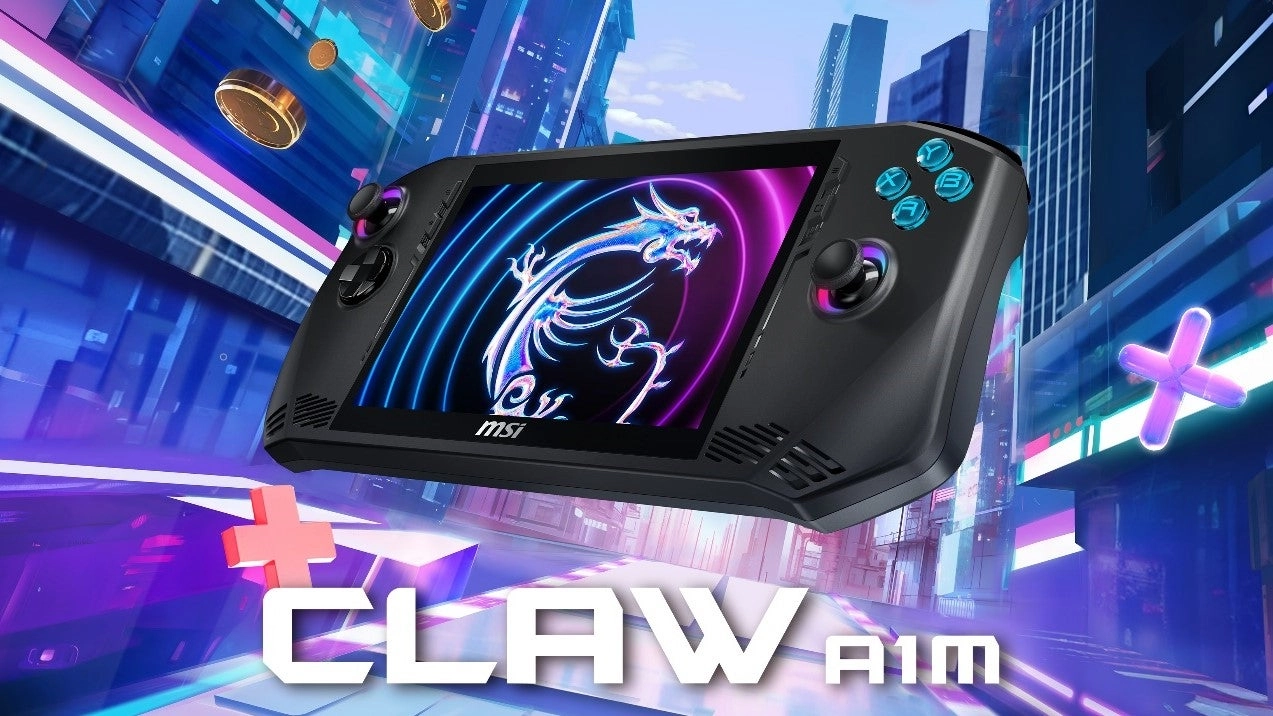
Beloved for their innovation in the gaming world, MSI has stepped into the spotlight with the announcement of an exciting new contender in the handheld gaming market—the Claw. This reveal came as a highlight of their showcase at the Consumer Electronics Show (CES) in 2024, and it's poised to spar with Valve's widely popular Steam Deck.
The naming convention MSI has chosen, "the Claw," hints at the device's ambition to grab a significant share of the portable gaming sector. The design of the Claw remains traditional without venturing into additional hardware frills, such as the detachable controllers seen on the Lenovo Legion Go. Instead, MSI is infusing the device with distinguishing features, setting it apart from its peers, most notably with its powerful new Intel processor and an impressively hefty battery.
Under the hood, the Claw is powered by an industry-first: a 14th-gen Intel Core Ultra 7 155H APU (Accelerated Processing Unit), which integrates Intel’s latest Arc graphics. This particular APU is the kind that's beginning to be adopted by high-end gaming laptops, indicating that MSI is aggressively targeting gaming performance in a handheld form. MSI is confident that this processor can handle demanding AAA games with smooth and immersive gameplay, a bold claim considering that the Steam Deck and its kind have historically utilized AMD APUs.
Adding to its appeal, the Claw boasts a 53Whr battery, outmatching even the Steam Deck OLED's 50Whr capacity. MSI promises that this beefy battery will sustain a full workload for around 2 hours, which in gaming terms references high-resource AAA titles. To illustrate, games such as Assassin's Creed Mirage and Horizon Zero Dawn tend to stretch just beyond two hours on similar devices, so it stands to reason that the Claw could possibly edge above its competitors in battery performance. However, this possibility might be challenged by the Claw's 1920x1080 IPS display that boasts both higher resolution and refresh rate—up to 120Hz—compared to the Steam Deck OLED, both factors that could impact power consumption.
Pricing and availability details for the Claw have not been disclosed as of the announcement, leaving eager gamers in anticipation. Price points are hoped to align with competitors like the Asus ROG Ally, which has seen recent price drops to make it more accessible. The Claw's Intel Arc graphics will need to work hard to validate any price premium that might be placed upon it due to its advanced specs.
The power consumption of the Intel APU remains a focal point of interest. With a base TDP (thermal design power) of 28W, the Core Ultra 7 155H is thirstier than its counterparts operating in the AMD realm, which can efficiently run games well below a 10W consumption range. The question remains whether the Claw's larger battery will compensate for the increased power draw or whether MSI has engineered a solution to dial in on efficiency without sacrificing performance.
While the spotlight was certainly on the Claw, MSI did not stop there at CES. A range of new gaming laptops, all sporting Intel’s 14th-gen CPUs and Nvidia GeForce RTX 40 series GPUs, were unveiled. These included several additions to MSI’s renowned product lines like the Titan 18 HX, Raider 18HX, as well as the mainstream Vector HX 16 and 17, the Crosshair HX 16 and 17, and the Pulse 16 and 17. Though perhaps not as uniquely named as the Claw, these updates signal MSI's commitment to pushing the envelope across their product offerings.
The advent of MSI's Claw indicates a significant shift in the handheld gaming industry, with heavyweight contenders like MSI entering the ring, leveraging cutting-edge chip technology to redefine what portable gaming can look like. Gamers around the world are watching with bated breath as this new device prepares to take on established names, potentially setting new benchmarks for gaming on the go.

You must be logged in to post a comment!
