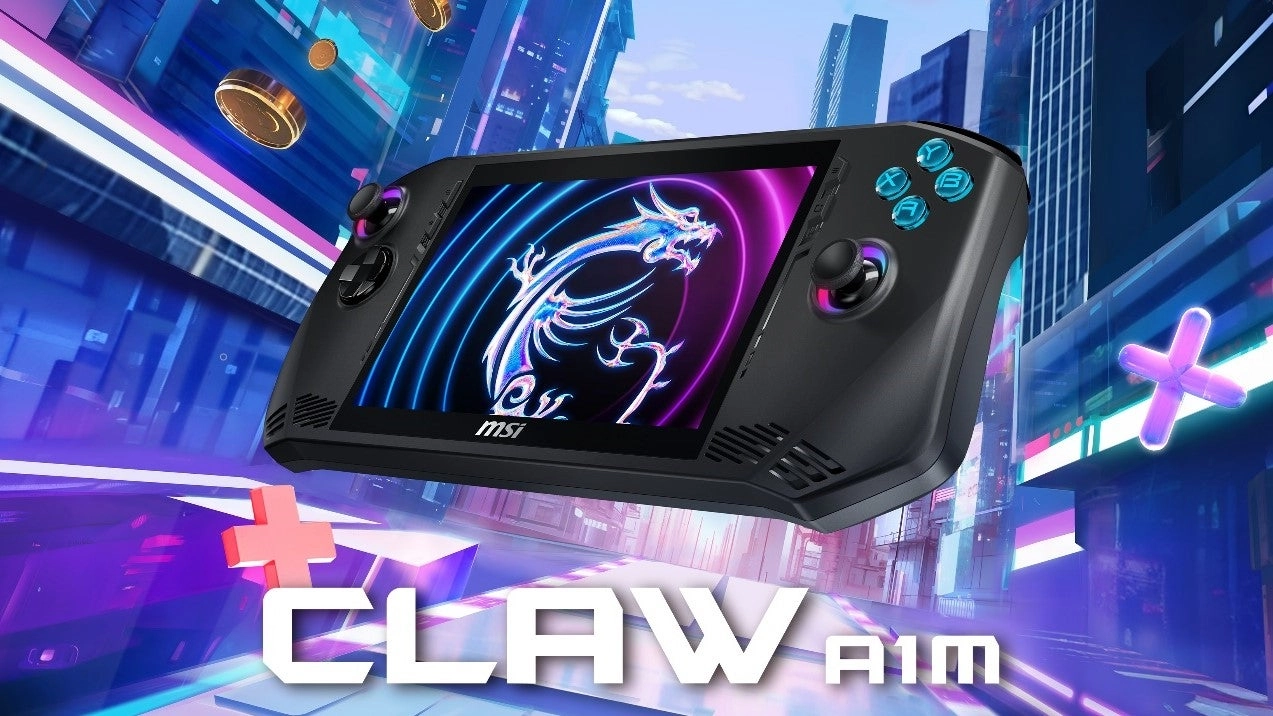
As the gaming industry continues to grow, major players in technology and gaming gear are consistently competing to capture the attention of gamers with innovative devices. MSI has stepped into the limelight with the announcement of the Claw, its brand-new handheld gaming device. Revealed during their showcase at CES 2024, the Claw emerges as a direct competitor to Valve's popular Steam Deck and resembles the Asus ROG Ally in more ways than one.
Unlike other handheld devices that run on AMD's APUs, MSI's Claw takes a different path by incorporating a 14th-gen Intel Core Ultra chip, the Intel Core Ultra 7 155H, which is typically found in high-end gaming laptops. This chip not only includes integrated Arc graphics but also promises to deliver a smooth and immersive gameplay experience. By choosing Intel over AMD, MSI is boldly diverging from the norm and betting on Intel’s tech to maintain competitive performance in the demanding portable gaming market.
Battery life is one of the most crucial aspects of any portable gaming device, and the Claw does not hold back in this department. It boasts an impressive 53Whr battery, which surpasses even the upgraded 50Whr cell found in the Steam Deck OLED model. MSI claims the battery can support 2 hours of gameplay even under full load, which is quite a statement considering the energy demands of AAA titles. Games such as "Assassin’s Creed Mirage" and "Horizon Zero Dawn" are known battery drainers, and if the Claw can truly match Steam Deck’s performance in battery life, it becomes a significant player in the field.
The device features a 7-inch IPS display with a resolution of 1920x1080, a notch above the usual portable gaming displays. This screen offers an impressive refresh rate of up to 120Hz, which can lead to smoother visuals, especially for action-packed games that benefit from high refresh rates. Despite these powerful specs, MSI has remained silent on the price and release date. Given the close competition in specs with other handhelds like the ROG Ally, the pricing strategy could heavily influence the Claw's market performance. Gamers will naturally seek value for money, and a price tag equivalent to its rivals will warrant attention.
However, the choice of high-spec components raises questions about energy consumption. The Core Ultra 7 155H chip's base Thermal Design Power (TDP) is 28W, considerably higher than the power usage of AMD's APU in the Steam Deck, which can run games well below 10W. This leads to speculation that the Claw's larger battery might be there to compensate for the Intel chip's greater power demands rather than extend the device's gaming time. Whether MSI has implemented any innovative efficiency tweaks to the chip remains a subject of curiosity for prospective buyers.
Alongside the Claw, MSI also unveiled a range of new gaming laptops powered by Intel's 14th-gen CPUs. These include update models across their product lines, such as the high-performance Titan 18 HX and Raider 18HX, as well as the more mainstream Vector HX 16 and 17, the Crosshair HX 16 and 17, and the Pulse 16 and 17. All of these laptops feature the latest Nvidia GeForce RTX 40 series GPUs, showcasing MSI's commitment to providing top-end gaming experiences across their product ranges.
The anticipation surrounding MSI's new Claw device is palpable, as it represents a potential shift in the portable gaming market by offering an Intel-powered alternative to the AMD-dominated scene. As the release approaches, gamers will closely watch to see if the Claw can indeed grasp a significant share of the handheld gaming sector. With its intriguing mix of powerful battery life, advanced display technology, and the allure of Intel’s latest chips, the Claw stands on the precipice of potentially joining or even leading the pack among portable gaming devices.

You must be logged in to post a comment!
