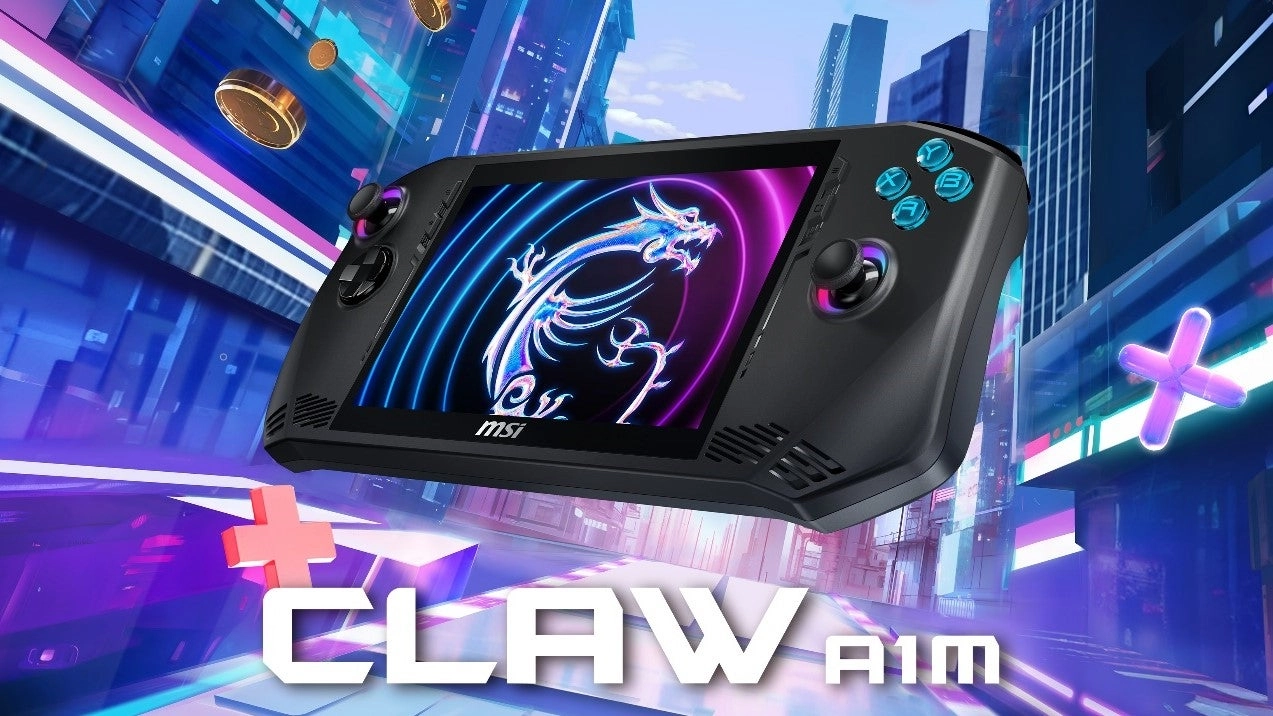
In the ever-evolving world of handheld gaming PCs, MSI has stepped up by revealing a new contender that may just go toe-to-toe with Valve's Steam Deck. Dubbed 'The Claw,' this device made its first appearance at CES 2024 and has caught the attention of gamers searching for power and mobility. Unlike devices that followed in the Steam Deck's footsteps, The Claw eschews the trendy AMD APUs for something rather distinct — an Intel Core Ultra chip.
The Claw opts for the Intel Core Ultra 7 155H—a powerhouse APU from the same family featured in premium gaming laptops. This choice could significantly alter the landscape of handheld gaming, given that prior models, including the Steam Deck, have consistently relied on AMD's APUs. MSI assures that their offering will deliver a “smooth and immersive gameplay experience,” even when tackling AAA titles.
Battery life stands out as a prominent feature. The Claw packs a 53Whr cell, which exceeds even the raised bar set by the Steam Deck OLED's 50Whr battery. MSI claims that The Claw should achieve a 2-hour battery life under full workload conditions, a phrase that likely translates to the most demanding gaming scenarios. Considering the performance of Steam Deck OLED's battery during heavy use, The Claw's additional capacity might provide it with a slight advantage, especially given its larger, high-resolution, and high-refresh-rate screen.
Speaking of displays, the MSI Claw is equipped with a sharp 1920x1080 IPS screen, which is more demanding than the Steam Deck's panel but delivers crisper visuals. Not only does it boast a higher resolution, but it also features a refresh rate of up to 120Hz, clearly outpacing the 90Hz offered by the Steam Deck OLED.
Despite the promise and performance this device might offer, details regarding its price and launch date remain elusive. Gamers and industry watchers alike would naturally hope that The Claw's price remains competitive, especially when compared to similar devices like the Asus ROG Ally. The pricing strategy will likely hinge on the performance of Intel's integrated Arc graphics—particularly whether it can deliver enough of a performance boost to justify any potential premium without undercutting the benefits provided by its larger battery.
Questions linger regarding the power consumption of The Claw. While the Core Ultra 7 155H is designed with a base TDP of 28W, the competition, including both models of the Steam Deck and the ROG Ally, have APUs that can operate efficiently under 10W. The conundrum here is whether MSI's larger battery is simply there to offset the higher power draw or if MSI has discovered innovative ways to enhance the chip's efficiency. Hence, keen interest swirls around the potential balancing act between power consumption and battery life.
Beside The Claw, MSI unveiled a series of new laptops riding the cutting edge with Intel's 14th-gen CPUs and Nvidia's GeForce RTX 40 series GPUs. These range from the high-end Titan 18 HX and Raider 18HX to the more budget-friendly Crosshair and Pulse series. Yet, none of these laptops carry the distinctly memorable monicker that 'The Claw' decidedly owns.
All in all, The Claw is poised to swivel heads in the portable gaming sphere. It's a trailblazer, sporting a first-of-its-kind Intel APU, promising exceptional performance, and touting a robust battery—all wrapped up in a portable form factor. MSI has clearly aimed to not just enter but make a statement in the handheld gaming market. The community eagerly awaits further details, hopeful that The Claw delivers on its promising features and proves to be not only a viable Steam Deck competitor but a superior choice for on-the-go gaming enthusiasts.

You must be logged in to post a comment!
